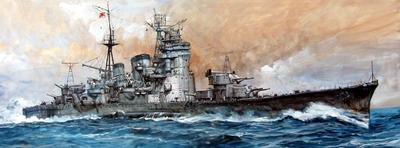
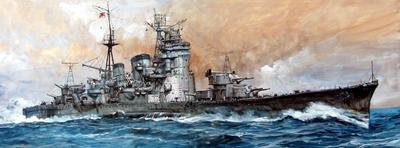
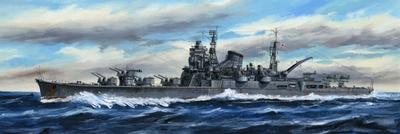
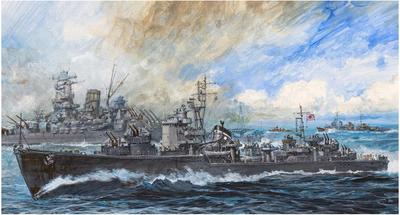
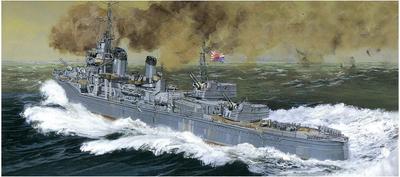
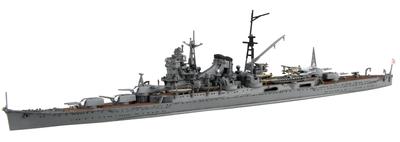
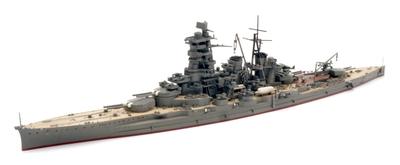
1/700 Special Series No.7 Japanese Navy Heavy Cruiser Myoko Plastic Model


Açıklama
Choose from various appearances from the start of the war in 1941 through 1944! New parts are included! This is an unpainted kit that requires assembly and painting. This 1/700 scale model does not include the ship's bottom. It is constructed using molds from the previous (special series) and newly added mold parts. The Myoko-class heavy cruisers were planned and constructed under the Washington Naval Treaty. Four ships were built: the lead ship Myoko, the Nachi, the Ashigara, and the Haguro. Completed in 1929 at the Yokosuka Naval Arsenal, the ship was equipped with five 20cm twin guns and four triple torpedo tubes, providing a balanced offensive and defensive capability. Before the outbreak of the Pacific War, the ship underwent two refits, including a 20.3cm main gun, a 13,000-ton displacement, and a 132,830 horsepower engine, giving it a speed of 33.8 knots. After the outbreak of war, the ship participated in and supported the Southern Invasion Operation, taking part in major fleet operations including the Battle of the Coral Sea, the Battle of Midway, and the Battle of the Philippine Sea. In October 1944, during the Battle of Leyte Gulf, it was hit by a torpedo and retreated to Coron. After emergency repairs, it headed for the mainland, but was rendered unseaworthy by a submarine torpedo attack. It was then towed to Haguro and moored at the Singapore Naval Port of Seletar as an air defense battery. After the war ended, it was seized by the British Navy and sunk at sea. This product allows you to choose from the appearances of the first Myoko-class ship, the "Myoko," at the start of the war (1941-), during the Battle of the Philippine Sea (1943-1944), or during the Battle of Leyte Gulf (October 1944). The 1941/start of the war ship featured a small aerial lookout and twin 13mm machine guns on both sides of the bridge. From 1943 onwards, during the Battle of the Philippine Sea, the model was equipped with the Type 21 radar, an increased number of 25mm twin machine guns, an air defense command post, and a windbreak. During the Battle of Leyte Gulf in 1944, the model featured the Type 13 and Type 22 radars, as well as triple and single 25mm machine guns. New molds were used to standardize the level of detail of equipment depending on the product's release date, and some parts were also divided to accommodate painting. The Type 13 radar features a sculpted truss structure and new included parts that recreate the shape of the antenna. The Type 21 radar features more detailed sculpting than previous included parts, such as the base of the insulator for fixing the front element. The Type 22 radar uses a slide mold to recreate the open state. The 12.7cm twin anti-aircraft gun A1 Kai 1 is subdivided into five parts, improving the modeling resolution from the existing two-part version. The 9-meter cutter is made into two parts for ease of painting, and the mount is available as a separate part, with the option of a one-piece molded deck. The 11-meter motorboat has separate canvas and wheelhouse/engine room canopy for ease of painting. Each part is painted and then assembled and glued later. The 12-meter motorboat launch can also be recreated without the canvas. The boat mount features molded irregularities and light holes for a more precise design. The chrysanthemum crest on the bow and the side lights on the bridge are available as new parts. The lifebuoys on the stern and bridge sides are available as dedicated parts. Parts included at the time of release have been updated to more recent standard parts. The 110-cm searchlight and 60-cm signal searchlight use common parts. The Kure Type 2 Type 5 launcher uses slide-molded parts. Binocular telescope parts have been added to the air defense command post and compass bridge. - Decals have been added for the stern ship's name (painted in naval colors) and the white line on the mast. - The Type 96 25mm machine gun is now a standard two-part design, reducing the amount of painting required. Hull - The hull has a one-piece structure with the port and starboard sides molded as a single unit, allowing for a more stable shape when assembled compared to a jointed assembly. - The bulge, a characteristic shape of the side, is depicted as an integral part of the hull. - The portholes are as they were at the start of the war, and the external electrical wiring is reproduced as a single sculpture on the hull. Decks - The upper deck is a single part, while the forward and shelter deck sections are separate parts, and the rear section is integrated with the hull. - Various features are reproduced, including the machine gun ammunition boxes, single machine gun mounting points, and hose reels. - The shelter deck is a separate part, and the torpedo equipment compartment on the lower level is also reproduced. Bridge and Mast: The bridge base, with its distinctive curved surface, is three-dimensionally recreated by combining the front and side parts. The upper lookout and air defense command post are provided with dedicated parts to recreate the differences between different years. Each deck, including the compass bridge and lower lookout, is meticulously recreated using a stacked structure. The forward mast is recreated with dedicated parts, depicting both the initial wartime and later revisions. Main Turret and Funnel: The main gun barrels are fixed and glued to the turret, while the turret incorporates polycaps for rotation. The rangefinder hoods for the No. 2 and No. 4 turrets include dedicated parts to recreate their final appearance. The front and rear funnels are both separated into left and right halves, and the handrails, double scaffolding, and steam exhaust pipes are depicted as a single piece. Aft Mast and Aviation Equipment: The aft mast is constructed by combining three separate parts, separated above and below the cross tree. The floatplane hoisting crane has been replaced with a hoist crane for a three-dimensional model. The aircraft work deck features linoleum-covered presser footings. Aircraft: The aircraft are molded in gray for improved workability (to prevent damage during gate cutting). Includes two each of the Type 95 floatplane, the Type Zero (three-seater) floatplane, and the Type Zero observation floatplane. This model is designed to recreate the loading conditions of two Type 95 floatplanes and one Type Zero floatplane from 1941-1942. This model is designed to recreate the loading conditions of two Type Zero observation floatplanes and one Type Zero floatplane from 1942 onward. Included decals: naval ensigns, national flags, and the Japanese flag for aircraft carriers. Naval ensigns and other markings are available in three sizes. The actual dimensions of the 10-, 6-, and 3-seat models are reproduced in 1/700 scale. Includes the Hinomaru (Japanese flag) and friendly identification stripe (yellow stripe) used on aircraft carriers, including the Hinomaru (Japanese flag) without the white border seen in the later stages of the war. Includes decals for the mast white line and stern ship name inscription (gold and solid warship colors). [Included Contents] 28 runners 1 assembly manual 2 decals *This product is made in Japan. *This is a plastic model kit that requires assembly. Plastic Model [Scale] 1/700