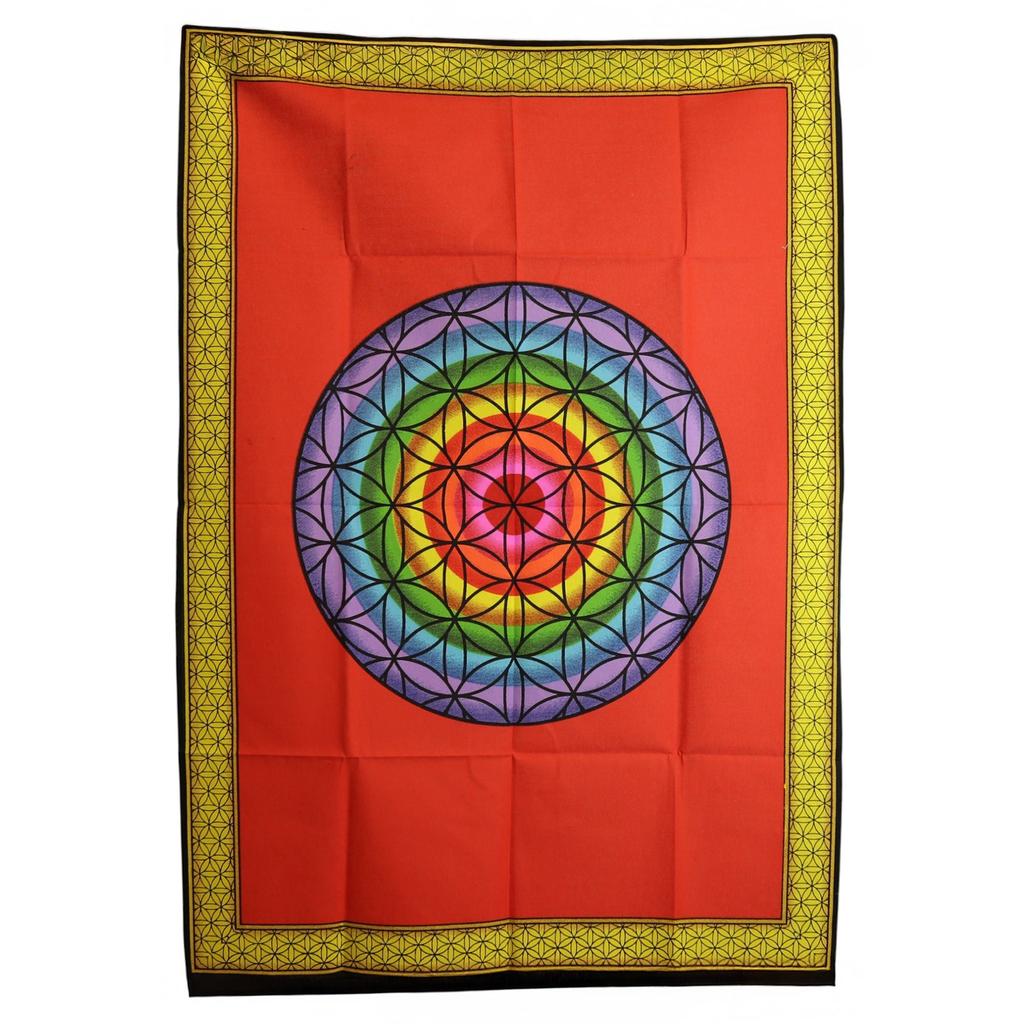
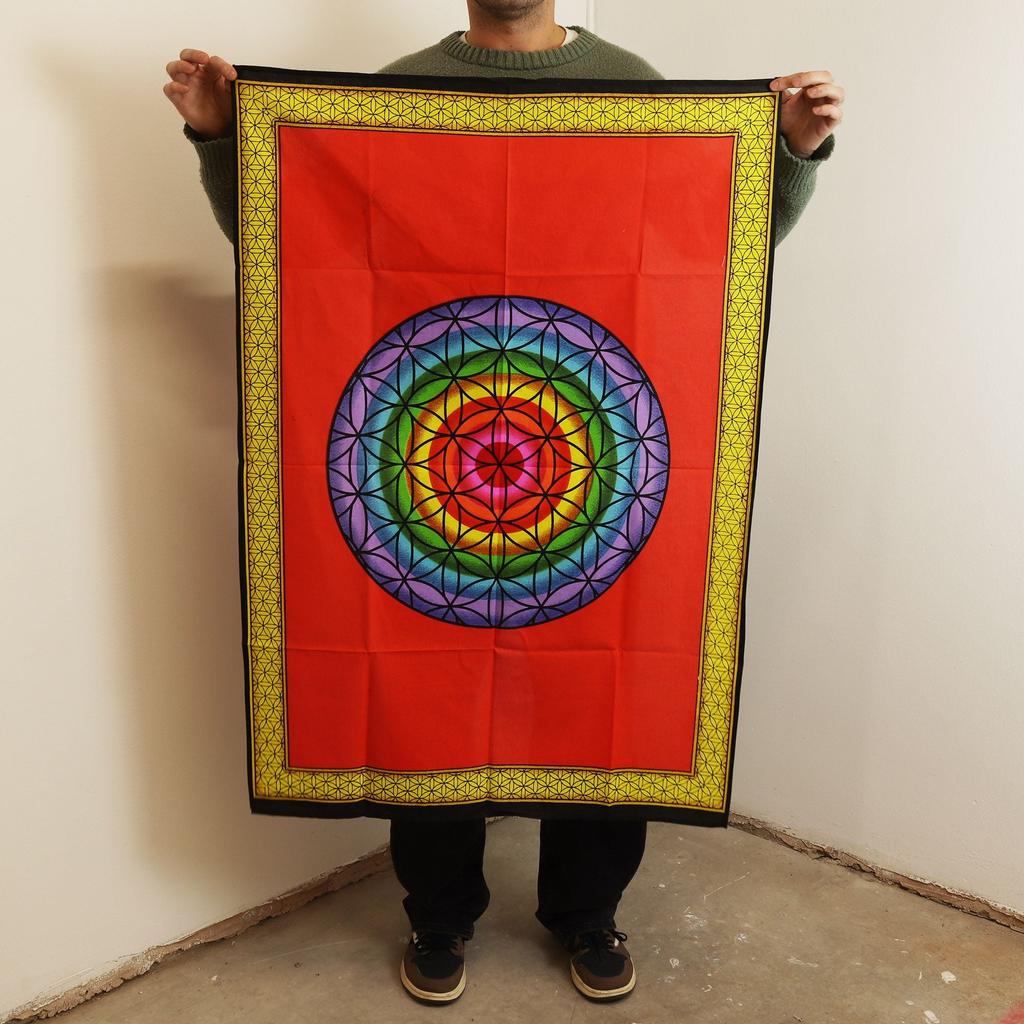
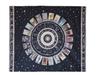
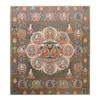
A screen-printed cotton wall hanging showing a single Flower of Life circle filled with rainbow-spectrum colour on a red background. This is the second Flower of Life design in the range — the other is the Five Flower of Life, which places five separate circles in different colours on the same red ground. This version goes the opposite direction: one circle, every colour. The rainbow treatment runs through the overlapping-circle geometry in a continuous spectrum from red through orange, yellow, green, blue, and violet. 70cm wide by 110cm tall, 95 grams, made in India.
What's Here
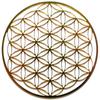
One large Flower of Life circle, centred. The Flower of Life is a geometric pattern made from 19 overlapping circles of equal size, arranged so that each circle's centre sits on the circumference of six surrounding circles. The result is a lattice of petal-shaped intersections — a pattern that looks organic and floral despite being constructed entirely from circles and straight geometry. The same pattern is covered in more historical detail in the Five Flower of Life listing; here it's worth knowing that the geometry is ancient, mathematical, and cross-cultural.
The rainbow fills the geometry with a continuous colour spectrum rather than assigning separate colours to separate areas. This creates a visual effect that the Five Flower of Life doesn't have: the overlapping petals shift colour as they cross the spectrum, producing transitional hues at the intersections. The geometry becomes a framework for colour rather than just a pattern.
Red background again — the same bold ground as the Five Flower of Life. This is the only background colour shared between two hangings in the range. Everything noted about red's room impact for the Five version applies here: warm, advancing, creates intimacy in large rooms and intensity in small ones, changes character substantially if it fades toward pink. If you're choosing between the two red-ground Flower of Life hangings, the background won't be the deciding factor — the pattern and colour treatment will.
The single-circle composition is simpler and more focused than the five-circle mosaic arrangement. There's one focal point, centred, with the red ground surrounding it. The visual weight sits in the middle of the hanging rather than being distributed across five elements. On the wall, this reads as a single statement rather than a collection.
No figures, no symbols beyond the geometry itself, no text. Like the Five Flower of Life and the Mandala Vibrant, this is pure pattern. But the rainbow adds a layer of association that plain multicolour doesn't carry — see the background section below.
Screen-Printed Cotton
Lightweight cotton, hemmed edges, screen-printed on one side. The rainbow spectrum requires careful colour gradation in the printing process — blending across multiple ink layers to create smooth transitions rather than hard colour boundaries. The red background is printed ink. The reverse shows a faded impression on natural cotton. Uncoated, unlined.
Placing and Looking After It
No hardware included. Pins, tacks, adhesive hooks, or clips at 95 grams.
The placement guidance for red backgrounds from the Five Flower of Life applies here without changes: red advances visually, makes walls feel closer, adds warmth, and works best in rooms that can absorb the intensity — larger spaces, rooms with warm-toned furniture and textiles, or spaces where you want a deliberate visual anchor. In small, cool-toned, or minimally decorated rooms, a red-ground hanging can dominate rather than complement. If you want the Flower of Life geometry without the red intensity, this design doesn't offer that option — both Flower of Life hangings in the range use red grounds.
The rainbow spectrum adds a consideration the Five version doesn't: this hanging contains every major colour, which means it can either tie a multicoloured room together (picking up on colours already present) or compete with a room that has its own strong colour scheme. It works best against neutral or warm backgrounds where the hanging itself provides the colour. Against a wall or room that already has strong blues, greens, or purples, the rainbow spectrum may create visual competition rather than harmony.
Hand wash gently in cold water if needed. Do not machine wash. The rainbow spectrum means uneven fading is a real possibility — lighter and warmer tones (yellows, light greens) typically fade before darker ones (blues, violets, deep red), which could shift the spectrum's balance over time. The red background will fade toward pink with sustained UV. Iron on the reverse at low heat to remove delivery creases.
What Rainbow Does That Other Colour Doesn't
Most of the colourful hangings in this range use colour decoratively — pinks here, greens there, gold accents, chosen for visual appeal. The